What happens when a grammar breaks down in public
Nothing you see in a painting is innocent. Not even what you call a faithful depiction. What appears as representation is already organized — shaped by conventions that determine which features of reality become visible, which disappear, and which never make it onto the canvas in the first place. This is not a claim about artistic intention. It is a claim about what images do.
The model we don’t question
We tend to think of art as representation. It is not obvious that this is what it does.
A painting is assumed to depict something. A photograph captures a moment. A film tells a story. In each case, the underlying model is the same: art reflects reality — perhaps imperfectly, perhaps interpretively, but always in relation to something that exists independently of it. The artwork points outward. Reality is the referent. The image is the record.
This model is so pervasive it rarely appears as a model at all. The problem is not that it is entirely false. It is that it misses what art does at its most interesting — and what art, at its most demanding, insists on doing whether the viewer is ready for it or not.
Art does not simply show what is there. It shows how what is there becomes visible.
Perspective is not a window
Consider linear perspective in Renaissance painting. It is routinely treated as a technical achievement — a way of representing space more accurately, of bringing depiction closer to how things actually look. But perspective does not reproduce space. It constructs a specific way of seeing it.
Organized around a fixed point. Structured by lines that converge at a horizon. Governed by a geometry that did not exist as an experiential given before being formalized, adopted, and distributed across centuries of production until it became invisible as a system and legible only as “realism.”
What appears as accuracy is, in fact, a grammar. The Florentine painters were not seeing more clearly than their predecessors. They were organizing the visual field according to a different set of rules — rules that suited particular interests, particular architectures, particular ideas about the relationship between the individual eye and the world it surveys. The viewer positioned at the vanishing point is not a neutral observer. It is a specific construction of the subject: centered, stable, sovereign over the visual field.
That construction did not describe how humans see. It prescribed how a certain culture thought humans ought to see.
When the grammar breaks in public
The history of modern art can be read as a sustained attack on that grammar. When Cézanne begins to fracture the unified picture plane, he is not failing to represent space correctly. He is refusing the convention that space presents itself from a single, stable point of view — because experience does not, in fact, work that way. When Cubism presents multiple perspectives simultaneously, it is not depicting confusion. It is depicting the actual structure of perception: composite, temporal, assembled from partial views rather than delivered whole.
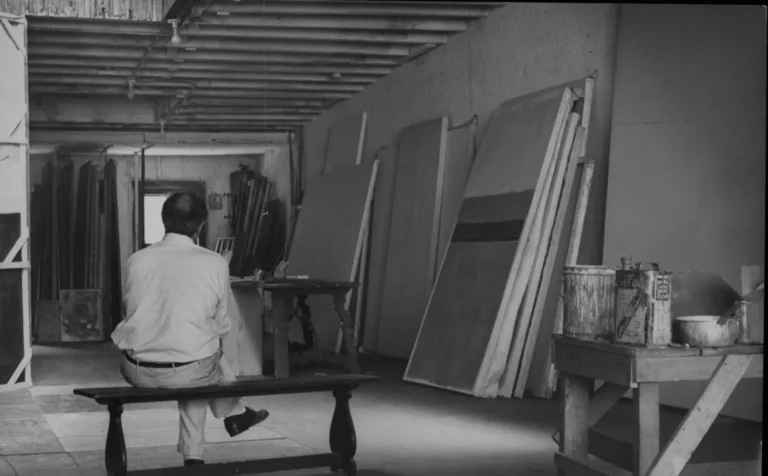
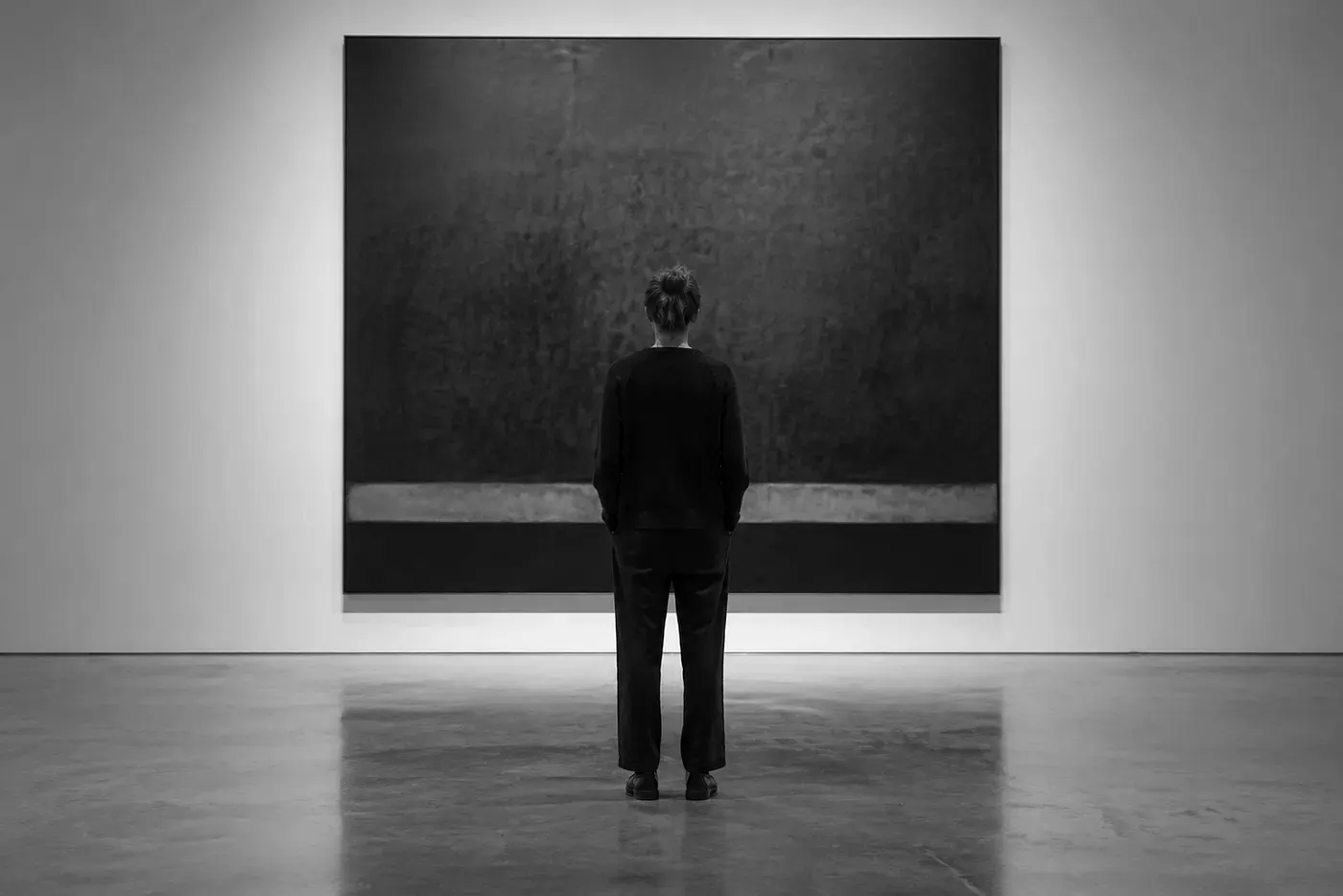
When Rothko reduces painting to fields of color that resist narrative, resist iconography, resist the very impulse to locate a subject, he is not abandoning representation. He is stripping away every convention that makes representation feel natural — leaving the viewer with something prior to the image: the raw condition of being in the presence of color, duration, and attention.
There is a moment — not everyone reaches it, and it does not always arrive in front of a painting — when the organizational system you have been using to make the visual field habitable simply stops working. Not because the image is confusing. Because it has removed, quietly and without apology, the convention that was doing the work. What remains is not chaos. It is something more disorienting than chaos: a field that is perfectly coherent, and completely unfamiliar. You are seeing. You do not know, for a moment, what you are seeing. That moment is the grammar becoming visible.
These are not departures from reality. They are exposures of what it cost to make reality appear familiar.
And familiarity, once exposed as a convention, becomes something you cannot fully recover. This is what difficult art does. It does not puzzle you because it is obscure. It unsettles you because it has removed something you did not know you were relying on.
The grammar you absorbed without knowing it
This is where art connects directly to the argument developed in the previous two pieces. Every act of representation operates through a grammar — a system of conventions that determines what appears, in what relation to what else, and with what degree of presence or absence. Photography looks more transparent than painting only because its grammar is less visible. The frame, the focal length, the shutter speed, the choice of what to include and what to cut — all of these are decisions, encoded so efficiently into the technology that they disappear as decisions and reappear as facts.
The documentary photograph feels like evidence. It is also an argument.
Pause on that for a moment. When you look at a press photograph from a conflict zone, you are not receiving information. You are receiving a frame — a rectangle of attention, carved from a continuous field, at a specific instant chosen by a specific person standing in a specific position for reasons that are never visible in the image itself. The photograph does not show you what happened. It shows you what was inside the frame, at the moment the frame closed. Everything outside that frame also happened.
It simply did not appear. This is not a failure of photojournalism. It is a structural feature of what photographs are. The grammar of photography does not produce distortion — it produces selection. And selection, presented as documentation, is among the most powerful epistemic acts a grammar can perform. Because it does not look like a choice. It looks like the world.
What art reveals that philosophy struggles to show
There is something art can do that propositional argument cannot. An argument describes the limits of a grammar from outside it — or tries to. But description is itself grammatical. The moment you begin to describe what a grammar excludes, you are using another grammar, with its own exclusions, its own blind spots. The regress is real and not easily resolved.
Art short-circuits this. A painting, a film, a piece of music does not describe the limits of a grammar. It instantiates a different one. It does not tell you that your conventions are conventions. It places you inside a different set of conventions and lets the friction speak for itself.
This is why certain works produce the sensation of having one’s perceptual furniture rearranged. Not because they are confusing — confusion is a cognitive state, and resolves when the right information arrives. What these works produce is something subtler: the recognition that the furniture was furniture. That what felt like the structure of experience was, in fact, a set of choices about how to organize experience.
That recognition does not resolve. It accumulates. And this is where art becomes epistemologically serious, rather than merely aesthetically interesting. It is not a softer version of philosophy, or a more accessible entry point to ideas. It is a different instrument for the same investigation — one that operates through experience rather than through argument, and that can therefore reach places argument cannot easily go.
The epistemological stakes
But here the argument risks becoming too comfortable. A reader who has followed this far may begin to feel that they understand — that the grammar is something one can learn to see from outside, calmly, analytically, without being inside it. This is precisely the illusion the argument should dispel, and doesn’t, if it proceeds too smoothly.
You are not outside the grammar. You are reading this sentence through one. Every field of knowledge operates through a grammar that structures what can be seen, what counts as evidence, what constitutes an adequate explanation. Science, law, economics, history — each produces its objects through a particular set of conventions, as the previous pieces have argued. What art adds to this picture is a demonstration that those conventions are not only intellectual. They are perceptual. They shape experience at a level prior to the formation of concepts.
Which means that changing a grammar is not only a matter of adopting different theories. It requires changing what it is possible to see.
This is why paradigm shifts in science are so slow and so violent, why legal revolutions feel like conceptual earthquakes, why economic transformations are accompanied by genuine disorientation rather than simple updating of beliefs. The grammar does not just organize thought. It organizes the perceptual field within which thought occurs. Changing it means, in a quite literal sense, learning to see differently.
Art is one of the few domains in which this process is made voluntary, deliberate, and — in the best cases — beautiful.
It does not tell you what to see. It trains the capacity to see that what you are seeing is always, already, a construction.
The question the series has been building toward
Three pieces. One framework. The first established that grammars organize what appears as reality — that the categories we use determine what becomes visible, what gets distorted, and what remains structurally absent.
The second applied that claim to its most consequential domain: the conceptual system that governs how modern societies understand, measure, and manage collective life.
The third has moved somewhere less obviously political, and in some ways more fundamental. Art is not a decoration on the argument. It is the argument’s clearest demonstration — the place where the constructedness of perception becomes not a thesis to be defended but an experience to be had.
The question the series has been building toward is not a new one. It is among the oldest in philosophy.
What would it mean to see without a grammar? To encounter the world prior to its organization into objects, relations, and the invisible space between them?
The honest answer is: we don’t know. We have never done it. Every attempt to strip away the conventions of seeing produces not raw experience but a different set of conventions — one that feels less familiar, and therefore more transparent, but is no less constructed.
What we can do is something more modest, and more useful. We can learn to notice the grammar. To feel its edges. To recognize the moment when what seems like a fact is, in fact, a choice — about what to make visible, what to leave outside, and who benefits from the arrangement.
That noticing does not dissolve the grammar. But it changes your relationship to it.
And that, in the end, is what philosophy, economics, and art — at their best, and on their best days — are all trying to do. Not to show you a world without structure. To make the structure visible.