On the floor of the studio at 157 East 69th Street, on the morning of February 25, 1970, lay a sixty-six-year-old man in a lake of blood. The lake measured roughly six feet by eight. Someone, surveying the scene, remarked that it looked like one of his paintings: a dense field of color, perimetered by the white of the tiles.
Mark Rothko left no note. He had told an assistant, months earlier: if I commit suicide, everyone will know it with certainty. There will be no doubt. The doubts, however, persisted. He wasn’t wearing his glasses, despite severe myopia. He had a phobic terror of blood. The witnesses contradicted one another. The painter Agnes Martin said simply: I don’t believe for one minute that Rothko killed himself. His daughter Kate asked her attorney to establish the cause of death with absolute certainty — not to close the grief, but to rule out that someone had murdered him.
That same day, the murals for the Seagram Building arrived at the Tate Gallery in London. The shipment had left weeks before. The coincidence was so perfect it seemed scripted.
A Thinker Trapped in a Painter’s Body
Marcus Rothkowitz — the original name, Latvian — did not want to be a painter. At eighteen, listening to Emma Goldman speak about workers’ rights, he was certain his path was political agitation. He had arrived in America at ten years old with a placard around his neck: I don’t speak English. His father Jacob died of cancer seven months after the family was reunited. He remained a foreign child with a country to decode, without a guide.
He arrived at Yale on a scholarship. When it wasn’t renewed, he washed dishes and delivered packages. Then he left without graduating — he simply decided to stop going. Painting was nearly an accident. An accident that lasted forty years.
What He Was Looking For in the Rectangles
The thirties and forties are the period when Rothko visibly wrestles with every available influence and exhausts them all. There is Nietzsche, Greek myth, Surrealism. Above all, there is The Birth of Tragedy: the idea that authentic art arises from the irresolvable tension between order and chaos, between form and dissolution. Rothko absorbed it not as literary influence but as a technical problem. How does one paint tragedy without narrating it? How does one transmit a fundamental emotional state without passing through narrative — which is already a mediation, already a distance, already a betrayal?
The answer arrived around 1949, and it was one of the most silent revolutions in twentieth-century painting. Rothko abandoned figures. He abandoned explicit myth. He abandoned everything that could be read as representation. What remained were the rectangles: two or three fields of color layered over grounds that vibrated in chromatic counterpoint, with deliberately blurred edges that prevented the form from closing, from becoming an object.
This was not abstraction in the sense of Mondrian or Kandinsky — geometry as structure, mark as symbol. It was something more radical: painting reduced to perceptual experience before the brain organizes it into recognizable categories, before culture intervenes to name and thereby neutralize.
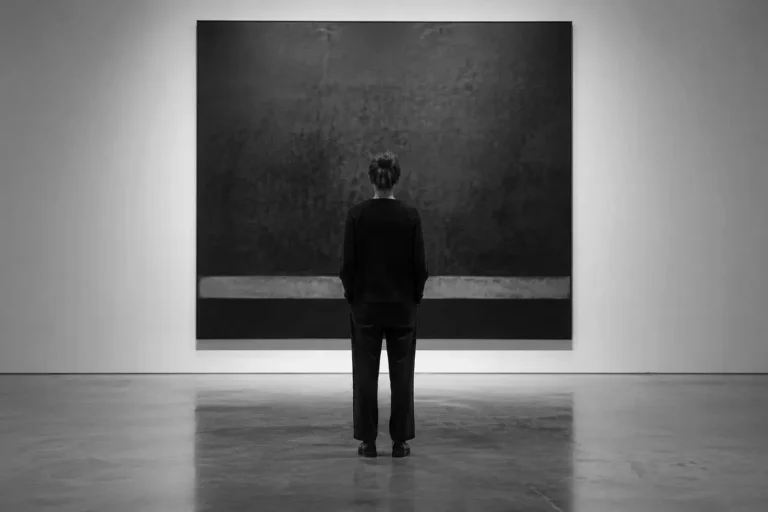
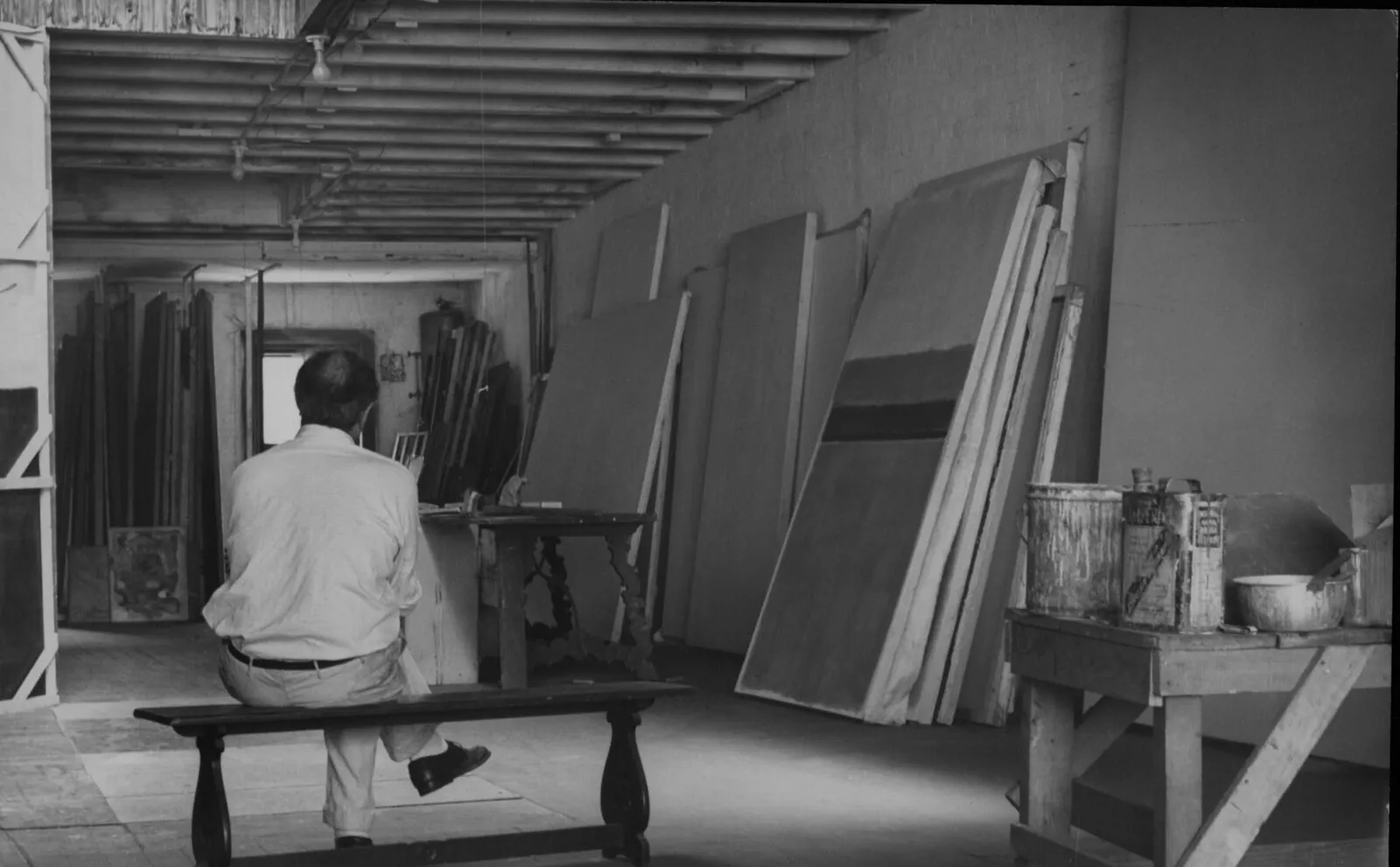
The technical process was obsessive. Rothko applied as many as twenty layers of glaze, each with a different concentration of pigment and binder, building surfaces that do not reflect light but absorb and return it variably depending on the angle. The red that becomes near-black in direct light, that opens into warm orange in raking light. The dimensions were not an aesthetic choice but a functional specification: canvases over six feet in height, calibrated to occupy the entire visual field of a viewer who approached within three feet. Not to be admired from a distance, the way one admires a landscape. To envelop. To remove the external vantage point. To render the viewer internal to the experience, rather than its judge from outside.
He controlled the lighting conditions with an attention that curators found exhausting. He visited exhibitions after the opening, alone, to verify that nothing had changed. It was the behavior of an engineer returning to the job site.
“I am interested only in expressing the basic human emotions — tragedy, ecstasy, doom,” he said. “The people who weep before my pictures are having the same religious experience I had when I painted them.” Not an intuition. A project.
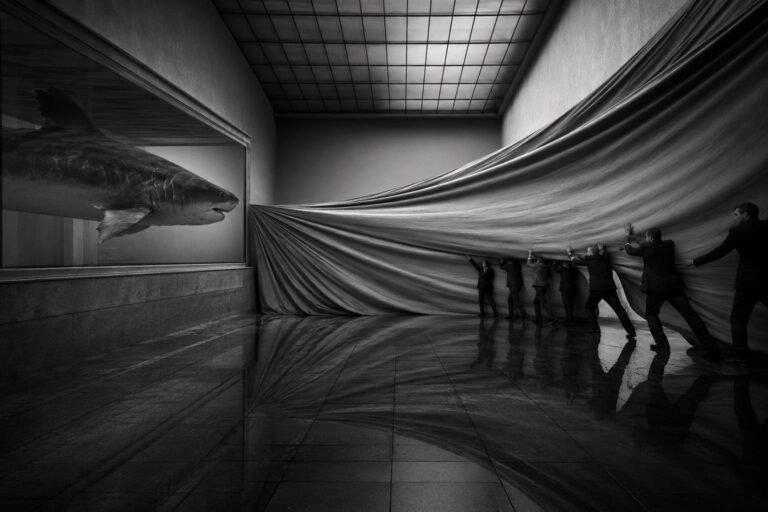
The art market took that painting and did precisely what he had said not to do: it stopped at the surface. It transformed the project into decoration, the experience into category. Color Field. New York School. Abstract Expressionism. Classifications that make the work saleable in exact proportion to their failure to understand it.
The Same Logic, Two Opposite Outcomes
In 1958, the Four Seasons Restaurant commissioned Rothko for a series of murals to adorn the dining room of the Seagram Building. Fee: thirty-five thousand dollars. Rothko accepted and worked for a year. Then he returned the money and kept the canvases.
The standard explanation — the indignant painter who refuses to decorate the banquets of the rich — is romantic and imprecise. Sitting at dinner at the Four Seasons, Rothko understood that the structural conditions of that space made impossible the type of experience for which the paintings had been designed. The wrong light, the distance imposed by the arrangement of the tables, the noise, the social function of the room. This was not an ethical problem. It was a compatibility check, failed — with the same coldness with which an engineer notes that a material cannot bear the intended load.
When René and Dominique de Menil proposed to him an interfaith chapel in Houston, he accepted without hesitation. The fee was incomparably smaller. The difference was not the money: the de Menils were offering him the only thing that no previous commission had ever offered. A space built for the paintings, around the paintings, in service of the paintings. The architecture would come after the canvases, not before.
Rothko worked on the project for six years. The chapel is octagonal; light enters from above through a diffused skylight — no direct source. The fourteen canvases are predominantly black, or near-black, with that quality of darkness that is not the absence of light but its transformation. The effect is one of visual silence that exists almost nowhere else in contemporary art: the canvases are not looked at, one inhabits them.
This was exactly what Rothko had spent forty years attempting with each individual canvas, finally realized in its most complete form. The Rothko Chapel opened in 1971. He had been dead for a year and never saw it finished.
The Market as Execution
In 1956, Rothko was teaching drawing to children at the Brooklyn Jewish Center to survive. He was forty-three years old and had no liquidity. He signed a contract with the Marlborough Gallery: the gallery would sell all his work in exchange for a fixed monthly fee. It was the kind of arrangement that made sense for an artist in his position.
Marlborough was directed by Francis Kenneth Lloyd — born Frank Levai, a Viennese art dealer with an infallible nose for value before the market recognized it and an equally infallible determination to extract maximum profit before the artist noticed. The technique was systematic: payments for Rothko’s work transited through accounts in Switzerland and Liechtenstein; the figures that reached the artist were falsified. Rothko continued to believe the market regarded him as second-tier, that his prices were stagnant. He signed the contract renewal in 1969 — already ill, already limited by an aortic aneurysm that had stripped him of the ability to paint large canvases — with a clause prohibiting him from selling to anyone else for eight years.
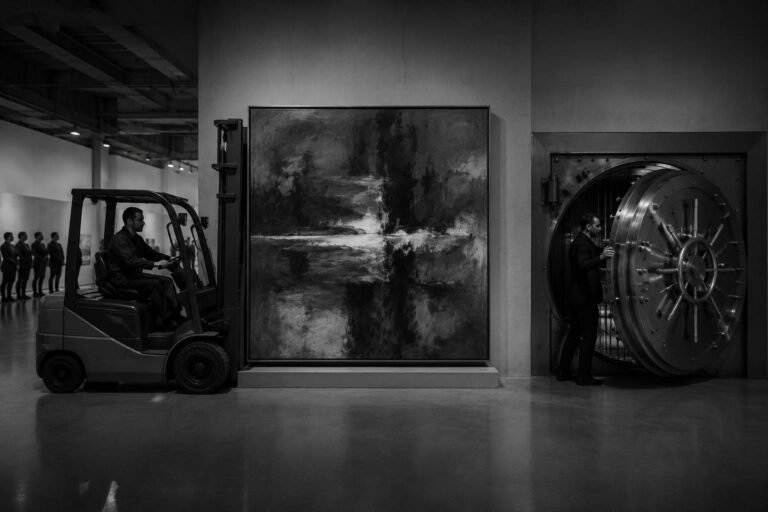
When he died, Marlborough held 798 of his paintings.
His children Kate and Christopher — she nineteen, he six — were informed that all the paintings belonged to the gallery. Their mother died of a stroke six months after their father. The critic Robert Hughes called them “the orphans”: a designation with the cruel precision of a verdict.
The trial that followed was the longest and most complex in the history of American art: eighty-nine days of testimony, eleven years of proceedings in total. It emerged that Bernard Reis — the accountant who had drafted Rothko’s will and been named executor of his estate — was simultaneously director, secretary, and treasurer of Marlborough New York. It emerged that Theodoros Stamos, artist and second executor, had signed a contract with the same gallery in the month following Rothko’s death. The New York Court of Appeals described their conduct as “manifestly wrongful and, indeed, shocking.”
The ruling imposed $9.2 million in damages. The paintings were returned. No one went to prison.
Rothko had never understood what he was worth. The gallery had taken care to prevent it. This — not the depression, not the illness, not the isolation, however real they were — is the most brutal fact of his biography: that the artist who had built his entire poetics on the refusal of mediation was destroyed by the most elementary and most contemptible form of it. The economic one.
There is a consoling version of Rothko that circulates in the catalogs: the Jewish mystic, the immigrant who transforms pain into light, the prophet of pure emotion. It is a version that would have enraged him. Because every gesture of his career — even the most apparently irrational — obeyed a single logic, coherent and inflexible: that painting must produce a real experience in the viewer, and that any condition preventing that experience must be refused, regardless of the cost.
In America, Rothko learned the language, the country, its hierarchies, its mechanisms of exclusion and co-optation. He never learned — and perhaps never wished to learn — how to defend the value of what one creates from those with a structural interest in not recognizing it. That gap, in the end, was fatal.
The paintings still breathe, in the half-light he had chosen for them. The question they pose has not yet found an answer. That is precisely why they continue to work.
Marcus Rothkowitz, Dvinsk, 1903 — New York, February 25, 1970.